
Safety GearArticle
Best Motorcycle Rain Suit for Delivery Riders 2026: Stay Dry, Stay Earning
Most riders quit in the rain. That is the opportunity. The riders still working at 9pm on a wet Tuesday are making real money. Here is the rain suit that keeps you out there.
Most delivery riders treat rain as a reason to go home. I used to be one of them. Then I tracked my earnings across a month of rain shifts versus dry shifts and realized I was leaving serious money on the table every time I made that decision.
When it rains in New York, order volume does not drop. People still order food. What drops is the number of riders on the platform. Every rider who goes home is one less competitor for the orders still coming through. Acceptance rates go up. Wait times at restaurants are shorter because fewer drivers are competing for the same pickup. I have had dinner blocks in January rain where my per-hour rate was 30 to 40 percent higher than a comparable dry block the same week.
The rain suit paid for itself in the first shift I wore it. Every shift since has been profit on that investment.
Quick Comparison: Best Rain Suits for Delivery Riders 2026
| Suit | Best For | Waterproof Rating | Reflective | Buy Now |
| Tourmaster Defender 2.0 | Best overall, full-time rain shift riders | Fully sealed seams | Yes | CHECK AMAZON PRICE |
| KEMIMOTO Rain Gear | Best value, most waterproofing per dollar | 15,000mm | Yes | CHECK AMAZON PRICE |
| HWK Motorcycle Rain Suit | Best packable, emergency rain coverage | 190T taffeta | Yes, 360-degree | CHECK AMAZON PRICE |
Each of these suits is on Amazon and available with Prime shipping. The Tourmaster Defender is the suit I would buy for regular serious rain work. The KEMIMOTO is the best value at its price. The HWK compresses small enough to live in your delivery bag as a permanent backup. I will cover each one properly.
Why Rain Shifts Pay More (And Why Most Riders Skip Them)
The delivery platform model is supply and demand in real time. Platform surge pricing and higher base pay per order are more common in rain because fewer riders are on the road. The riders who go home are not wrong about rain being uncomfortable. They are wrong about the math.
Here is what I have observed across multiple rainy shifts in Brooklyn, Manhattan, and the Bronx:
Restaurant wait times drop. During a busy dry Friday dinner rush, I am often waiting four to eight minutes at a pickup. On a rainy Tuesday, I am in and out of the same restaurants in two minutes because the volume of incoming orders has not dropped but the number of drivers competing for the same pickups has.
Order acceptance improves. In normal conditions, I can afford to be selective about which orders I accept. In rain conditions, being one of the few riders still working means I can be even more selective and still maintain a full queue.
The actual discomfort of a rain shift in good gear is surprisingly manageable. Cold and wet without gear is miserable. Dry and warm inside a good rain suit, with waterproof shoe covers and waterproof gloves, rain becomes ambient background rather than the thing ending the shift.
The riders who know this already own the gear. The riders who do not have convinced themselves that rain shifts are not worth it. The gear is what separates those two groups.
Best Overall: Tourmaster Defender 2.0
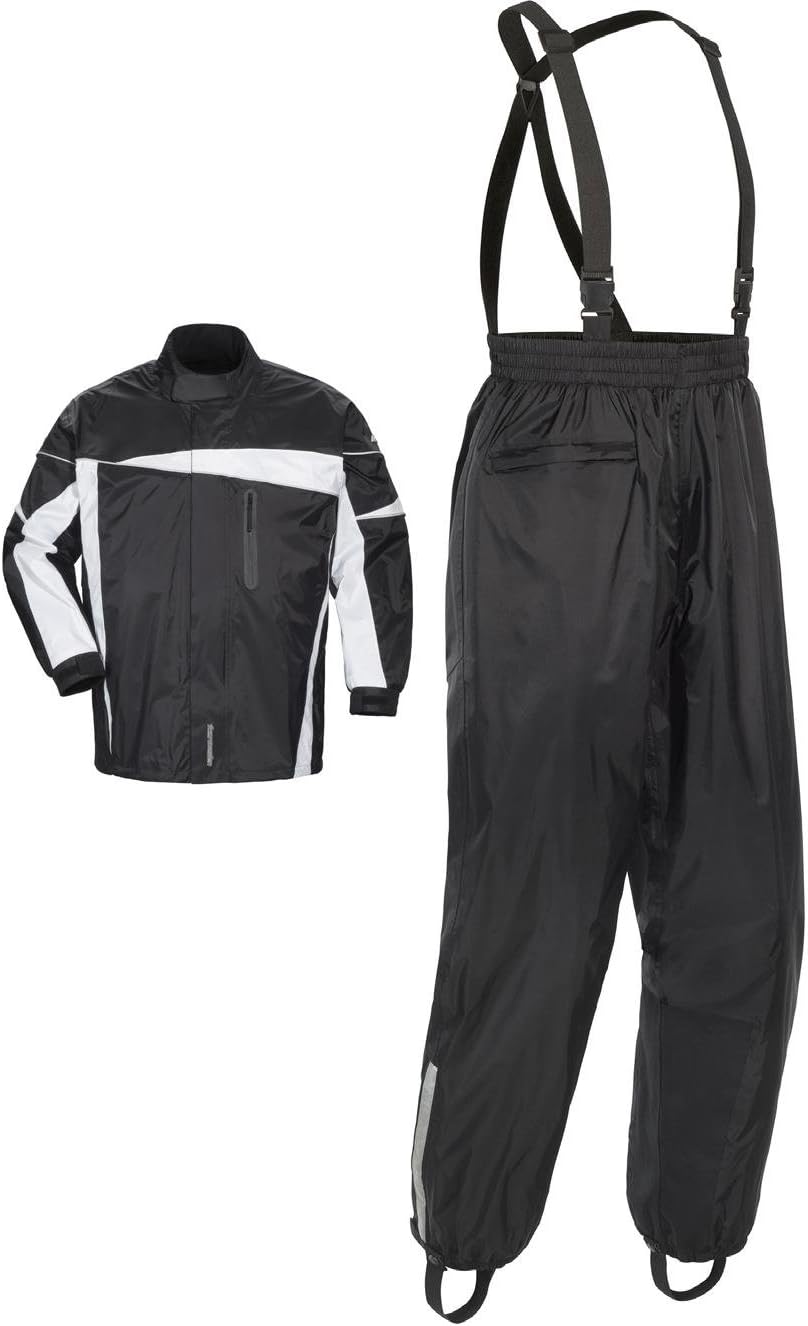
The Tourmaster Defender 2.0 is what I would buy if I were choosing one rain suit for full-time delivery work with no other constraint. It is motorcycle-specific in its design and materials, not an outdoor jacket adapted for riding use, and that distinction shows up in how it performs over a multi-hour shift.
The polyurethane-backed nylon shell is fully sealed at the seams. This is the single most important specification to look for in a rain suit and the one that budget options almost always compromise on. Sealed seams mean water cannot enter through the stitch holes that run through the fabric at every seam junction. Partially sealed or unsealed seams are where budget rain suits fail first, usually after 90 minutes to two hours of sustained heavy rain.
The aqua-barrier inner collar extends up under the helmet to prevent rain from running down the neck gap. In a delivery shift context, this matters because you are stopped frequently at restaurant doors and pickup points where the rain falls vertically rather than streaming across the suit horizontally as it would at riding speed. Standing at a restaurant entrance for three minutes in heavy rain is a vertical-rain test the suit has to pass.
The pants come with suspenders that allow a custom fit and keep the waist seal in place during repeated mount-and-dismount cycles. Budget suits without this feature tend to drift down at the waist over a shift, opening the gap between jacket and pants to rain infiltration. On a delivery block with 25 stops, that drift adds up.
Underarm vents zip open when you want airflow between pickups and close when you need full rain protection while riding. At stop-and-go delivery speeds in warm-weather rain, those vents are the difference between arriving at each restaurant sweaty and arriving at a manageable temperature.
The one thing I do not love about it:
The ankle fit is snug. Multiple reviewers note that getting the pants on over thicker boots can require removing the boot, putting the pant on, and then putting the boot back on. On a first deployment before a shift, that is a five-minute process. It becomes faster with practice, but it is worth knowing before your first wet shift with this suit.
The price sits around $90 to $110, which is the right number for what this suit does. At this price the quality justifies the cost. If your budget starts lower, read on.
- Fully sealed seams, the spec budget suits always compromise on first
- Aqua-barrier collar blocks vertical rain at restaurant stops
- Suspender pants keep waist seal intact across 25+ stops per shift
- Underarm vents manage heat between pickups in warm-weather rain
- Motorcycle-specific design, not an adapted outdoor jacket
- Snug ankle fit, may require removing boots to get pants on
- Higher price point (~$90–$110) versus the other two options
- First deployment takes ~5 minutes until you build the routine
Best Value: KEMIMOTO Waterproof Rain Gear
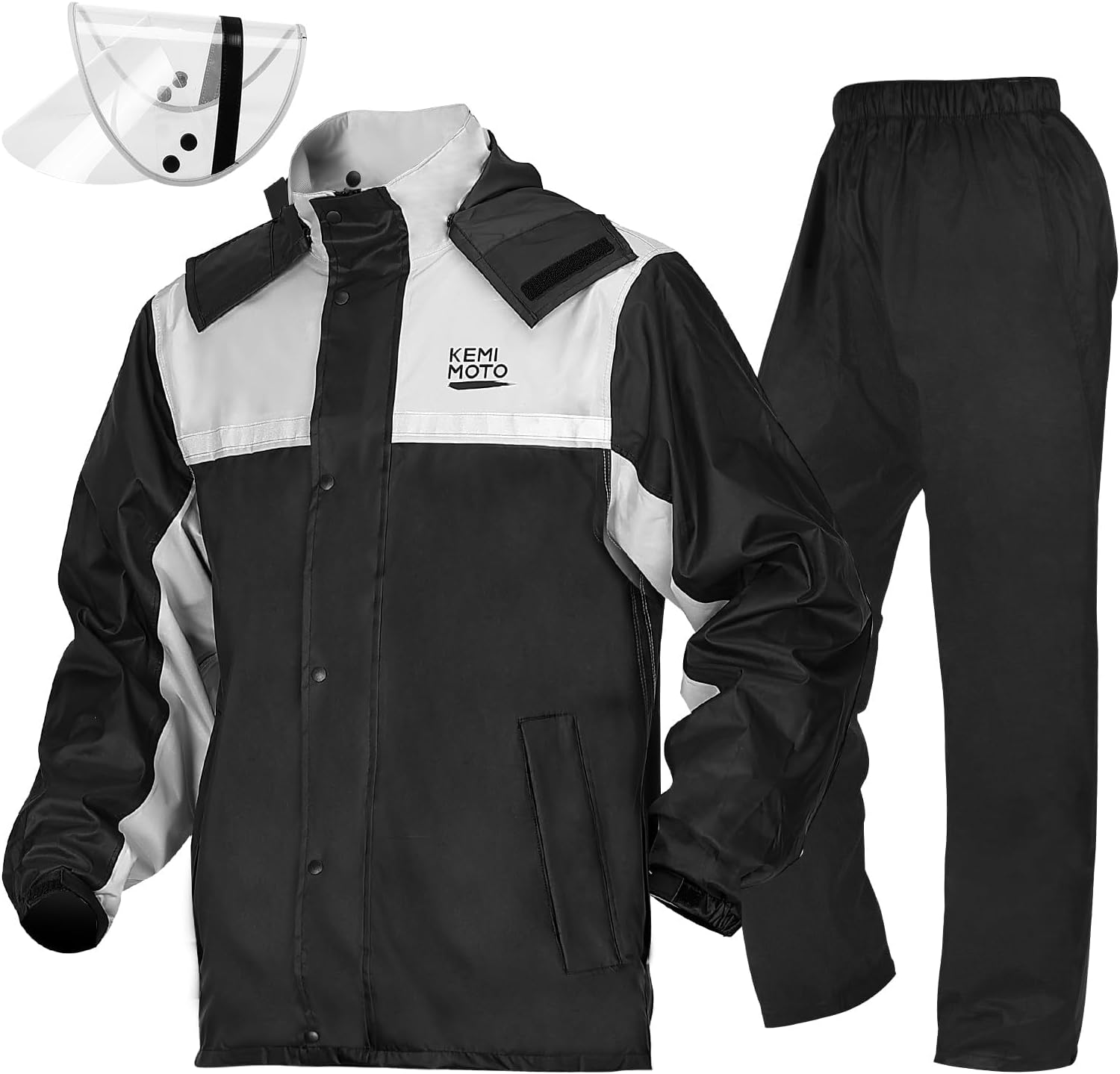
The KEMIMOTO is the suit I put in the budget article as the best under $80, and it deserves a mention in the hub article too because the 15,000mm waterproof rating at $45 to $65 represents genuine value at a level that most rain suit roundups underestimate.
For a delivery rider doing rain shifts a few times per week rather than every shift, the KEMIMOTO hits the right balance. The full-shift rain protection is real, the 360-degree reflective strips are well-placed for night work, and the mesh inner lining takes some of the clamminess out of the interior without adding meaningfully to the price.
The one thing I do not love about it:
The breathability gap versus the Tourmaster is noticeable in a long shift. Two hours in the KEMIMOTO during warm-weather rain and you are aware of the heat inside. The Tourmaster's design manages airflow better through the vent system. If you are doing long summer rain blocks, the KEMIMOTO will leave you sweating inside it before the shift is done. If you are doing colder-weather rain shifts where the heat buildup is actually a benefit, that distinction disappears.
Full breakdown in the budget rain suit guide: Best Motorcycle Rain Suit Under $80 for Gig Delivery Riders →
- 15,000mm waterproof rating at $45–$65 is genuine value
- 360-degree reflective strips well-placed for night work
- Mesh inner lining reduces clamminess without adding cost
- Solid choice for riders doing rain shifts a few times a week
- Noticeable breathability gap versus the Tourmaster on long shifts
- Heat buildup becomes uncomfortable in warm-weather rain after ~2 hours
- Slightly restrictive in the shoulder area for high-frequency dismounts
Best Packable: HWK Motorcycle Rain Suit
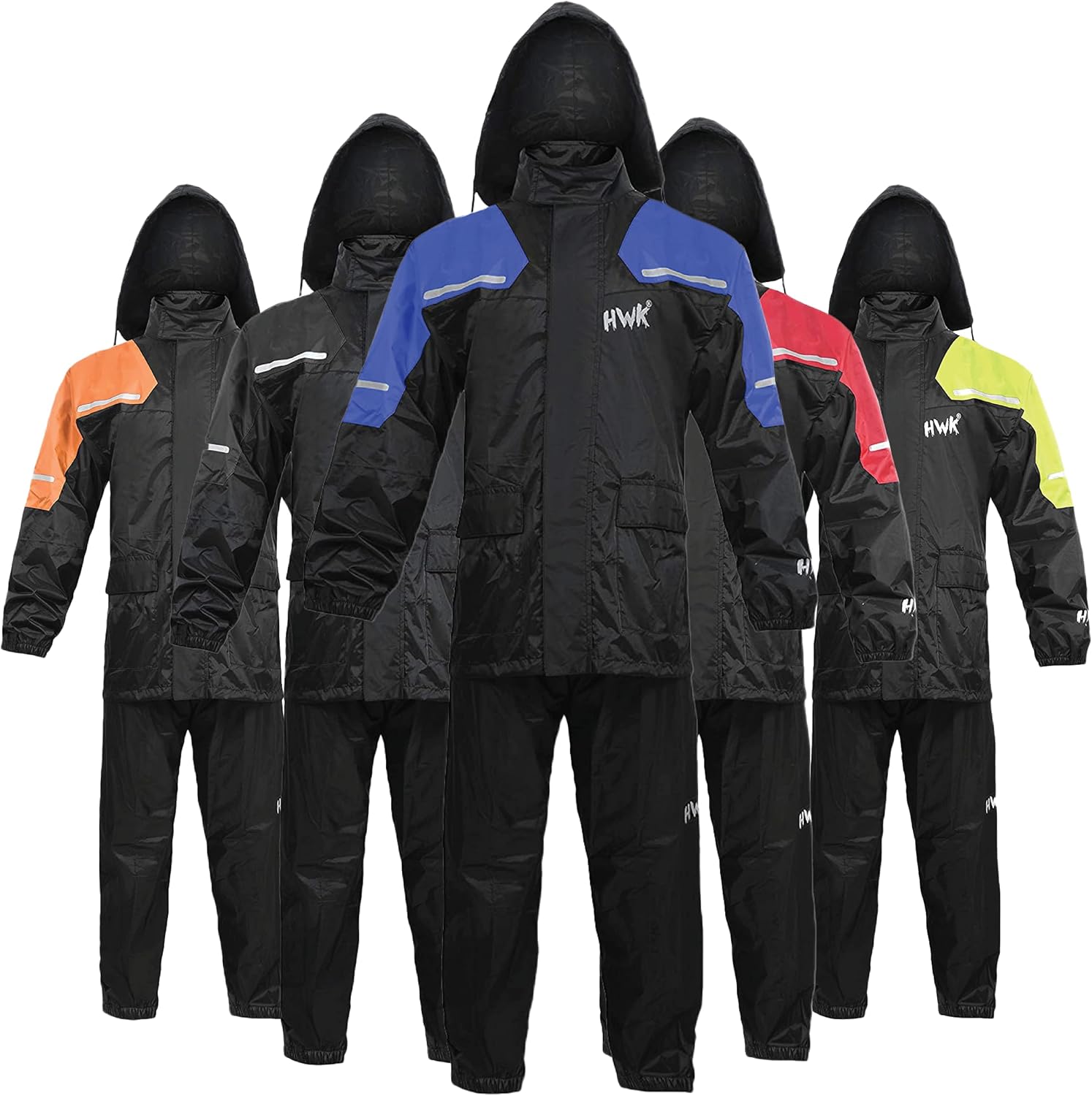
The HWK earns its spot on this list for one specific reason: it compresses small enough to fit in a delivery bag and stay there permanently as a backup for unexpected rain.
Most delivery riders have had the experience of starting a shift in clear weather that turns into rain mid-block. Without rain gear on the bike, the choice is to ride wet or call the shift early. The HWK in its compressed state takes up about the same space as a large insulated bag insert. It lives in the bag and you forget it is there until you need it.
The 190T taffeta polyester fabric is lighter than the KEMIMOTO or the Tourmaster, which is the reason it compresses as well as it does. The 360-degree reflective trim on the jacket and pants is one of the better reflective setups in this price range. Front, back, sleeves, and pant legs. For unexpected rain in the middle of an evening block, the visibility the HWK provides in low-light conditions is important.
The one thing I do not love about it:
The lighter fabric has a shorter waterproofing lifespan than the Tourmaster or KEMIMOTO under daily use. The 190T taffeta is the right trade-off for a packable emergency suit, not for a suit you deploy on every rain shift. If you are wearing the HWK three times per week in heavy rain, the water-resistance coating will degrade noticeably within a season. Use it as your bag backup. Use the Tourmaster or KEMIMOTO as your planned rain shift suit.
- Compresses small enough to live in the delivery bag permanently
- 360-degree reflective trim on jacket, pants, sleeves and legs
- Turns an unexpected downpour into a 3-minute gear deployment
- Lightest of the three, best packability trade-off at the price
- Lighter 190T taffeta fabric degrades faster under daily heavy rain use
- Water-resistance coating noticeably degrades within a season if overused
- Suited to emergency backup use, not as a primary rain shift suit
What to Wear Under the Rain Suit
What you wear under the rain suit matters more than most riders account for.
In cold rain (below 50 degrees): A thermal base layer under your existing jacket, then the rain suit over everything. The base layer keeps core warmth up. The rain suit keeps the cold water out. Do not skip the base layer in cold rain thinking the rain suit will compensate. It will not. It keeps rain out but it does not add warmth.
In mild rain (50 to 65 degrees): Your regular riding jacket or hoodie under the suit is fine. A moisture-wicking mid-layer helps if you are going to sweat inside the suit. Cotton under a rain suit in a warm rain block is uncomfortable. Wicking synthetic fabric makes the sweat factor manageable.
In warm rain (above 65 degrees): Consider the rain suit over a mesh jacket rather than a heavier jacket. The mesh allows the rain suit to sit closer to your body without the bulk of a layered insulating jacket, which helps with freedom of movement at restaurant stops.
The Rain Suit On-and-Off Decision
On a delivery block, rain is not a static condition. It starts, it stops, it lightens, it gets heavier. The decision about when to put the suit on and when to take it off is one most riders get wrong until they have done it a few times.
My rule: if the forecast shows any meaningful rain probability during my shift window, the suit goes on before I leave. Not at the first restaurant when the rain starts. Before I leave. Getting the suit on at home in dry conditions takes two minutes. Getting it on while already partially wet outside a restaurant takes ten.
Two-piece suits are better than one-piece for delivery riding specifically because they allow partial deployment. A light drizzle might only warrant the jacket. A heavier block warrants both pieces. One-piece suits force an all-or-nothing decision every time.
Store the suit compressed in the delivery bag between uses. Do not fold it the same way every time. Repeated folding at the same crease points creates permanent creases that eventually crack the water-resistant coating. Roll it loosely or fold it in varying directions.
Rain Suit + Gloves + Shoe Covers: The Full Wet-Weather Stack
The rain suit handles your core and legs. Two other pieces complete the protection.
Waterproof gloves for your hands and brake lever grip. Wet hands on wet levers are a friction problem. A good pair of waterproof gloves keeps the lever contact dry regardless of how hard it is raining. Best Motorcycle Gloves for Delivery Riders
Waterproof shoe covers for your feet at every restaurant stop. Standing water at curb cuts and restaurant entrances wicks into regular shoes within minutes. Shoe covers eliminate that entirely. The shoe covers article is the most important wet-weather gear piece most delivery riders have not thought about yet. Best Waterproof Shoe Covers for Delivery Riders
For the full system including layering, drying gear between shifts, and what order to buy each piece if budget is a constraint: Waterproof Motorcycle Gear for Delivery Riders: Full Setup Guide
E-Bike and Bicycle Riders: Do Rain Suits Work for You?
Yes. And they may matter even more for e-bike and bicycle delivery riders than for motorcycle and scooter riders.
Here is why. E-bike delivery riders tend to do more stops per shift because order distances in dense urban markets are shorter. More stops means more time standing outside restaurants in the rain. The rain suit that keeps a motorcycle rider dry at 30 mph between orders also keeps the e-bike rider dry at 12 mph and standing still outside a pickup location.
The fit consideration for e-bike riders: you are mounting and dismounting the bike more frequently and the range of motion you need is slightly different from a motorcycle rider. A suit that is slightly more generous in the shoulders and hips makes the on-and-off at restaurant stops faster. The Tourmaster Defender handles this well. The KEMIMOTO is slightly more restrictive in the shoulder area but manageable for most riders.
The rain suit does not care what is powering the bike. The water management works the same way at city delivery speeds regardless of vehicle type.
The Bottom Line
Rain shifts are where experienced delivery riders make disproportionate income. The barrier is gear, not skill. A rider who stays dry through a wet Tuesday night earns more than a rider who goes home because they did not have the right equipment.
The Tourmaster Defender 2.0 is the suit for riders who work through rain regularly and want a suit that performs over a full career of rain shifts. The KEMIMOTO is the right starting point for riders who want serious waterproofing at a lower entry cost. The HWK lives in your bag as the permanent backup that turns an unexpected downpour into a three-minute gear deployment rather than a reason to end the shift early.
Buy the suit. Work the rain blocks. The math works out.