
Tech & LightingArticle
Camera in Motorcycle Helmet 2026: Best Options for Delivery Riders
Camera-in-helmet options fall into two camps: clip-on action cameras and helmets with cameras built in. Here is what to buy based on how you actually ride.
Two options, two different trade-offs. A clip-on action camera mounts to any helmet you already own. A helmet with a built-in camera is a single device that does both jobs. Which makes more sense depends on what you already have and how you work.
I will lay out both clearly so you can make the call without wading through everything that does not apply to your situation.
Clip-On vs Built-In: The Core Decision
Clip-on action camera:
You keep your current helmet. You add a camera that mounts to it. If the camera fails, breaks, or you want to upgrade, you replace only the camera. If you upgrade helmets later, the camera transfers. The upfront cost is the camera plus a chin mount adapter, purchased separately.
Built-in camera helmet:
One device, one purchase, no external mount. The camera is integrated into the shell so there is nothing to clip on, nothing to lose, and nothing that adds wind resistance. The trade-off is that when the helmet reaches end of life in three to five years, you replace the camera too whether you want to or not. The camera is not transferable.
For delivery riders who already have a good helmet, the clip-on is almost always the right starting point. You protect the safety investment you already made and add documentation capability on top of it.
For riders buying a helmet from scratch who want a clean single-device setup, the built-in is worth the premium.
Quick Comparison
| Option | Best For | Camera Transferable? | Buy Now |
| GoPro Hero 13 Black (chin mount sold separately) | Riders with existing helmet, best footage quality | Yes | CHECK AMAZON PRICE |
| DJI Osmo Action 5 Pro (chin mount sold separately) | Night shift riders, best low-light | Yes | CHECK AMAZON PRICE |
| Insta360 GO 3S | Lightest option, forget it is there | Yes | CHECK AMAZON PRICE |
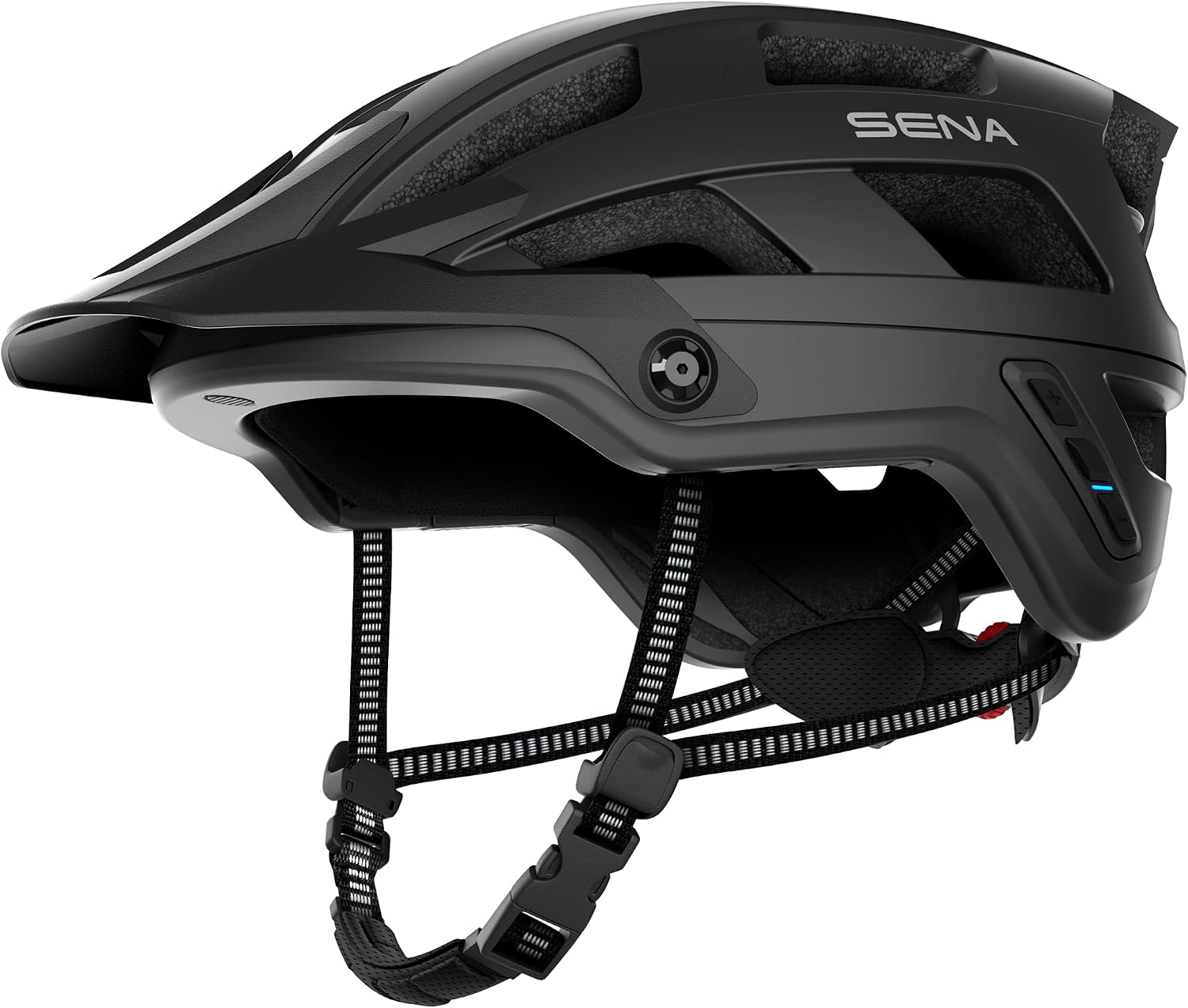
| Sena M1 EVO (built-in camera + Bluetooth) | New helmet buyers, single device | No | CHECK AMAZON PRICE |
Important: The GoPro Hero 13 Black and DJI Osmo Action 5 Pro do not include a chin mount. The chin mount adapter must be purchased separately.
Clip-On Options: What to Mount and Where
The Right Camera for Delivery Work
The full breakdown of which clip-on camera is right for your shift conditions is in the helmet camera hub article: Best Motorcycle Helmet Camera for Delivery Riders 2026.
The short version for mounting purposes:
GoPro Hero 13 Black is the pick for daytime and mixed conditions. Best stabilization, magnetic quick-release, waterproof. The chin mount is not included; it is a separate accessory available on Amazon.
DJI Osmo Action 5 Pro is the pick for evening and night shift riders. Better low-light than the GoPro. The chin mount adapter is not included with the camera and must be purchased separately. DJI makes an official chin mount adapter, and third-party alternatives are also available.
Insta360 GO 3S is the pick for riders who want the smallest possible footprint. 39 grams, barely noticeable on the chin bar. Works with standard GoPro-compatible or brand-specific chin mount adapters, sold separately.
None of these cameras are bundled with a chin mount in the box.
Mounting Position: Chin Bar Is the Right Call for Delivery Riders
Three mounting positions are commonly used on motorcycle helmets: top, side, and chin.
Top mount gives you the widest forward view and the cleanest sky-to-horizon footage. It is the right position for content creation. It is the wrong position for delivery documentation. A top mount does not capture your hands, the handlebars, or the interaction at a restaurant door.
Side mount captures lane position and traffic to one side. Useful for incident documentation involving vehicles on that side. It misses the forward interaction at pickups.
Chin mount angles down at approximately 15 to 25 degrees from horizontal. It captures the forward road, your gloved hands on the handlebars, and the scene at any delivery stop. When you approach a restaurant door, the chin mount captures the handoff at roughly the angle and height of a witness standing beside you. For dispute documentation, this is the only position that matters.
Chin Mount Adapters: What to Buy
Chin mount adapters are sold separately from action cameras. They are not bundled in the box with any of the cameras listed here. They attach to the chin bar of open-face and full-face helmets via adhesive bases on smooth surfaces, or strap attachments on vented or textured surfaces.
GoPro-compatible chin mount for the Hero 13 or any GoPro-threaded camera. Confirm your helmet's chin bar geometry before ordering, since some full-face helmets have a pronounced curve that standard flat-base adapters do not sit flush on.
DJI official chin mount adapter for the Osmo Action 5 Pro. DJI sells an official version, and third-party alternatives are generally adequate for delivery use.
Insta360 GO 3S chin mount available from Insta360 directly or as a GoPro-compatible third-party adapter.
Installation takes 15 to 20 minutes on a first setup. The adhesive base requires 24 hours to fully cure before riding. Do not ride the same day you install an adhesive mount.
Built-In Camera Helmets: Who They Are Actually For
Sena M1 EVO
The Sena M1 EVO integrates a camera, Bluetooth speakers, and a microphone into a single helmet unit. For delivery riders, the Bluetooth speakers are the feature that makes this genuinely useful beyond documentation: navigation audio through the helmet means you hear turn-by-turn directions without earbuds or a phone speaker you cannot hear at speed.
The built-in camera records forward footage automatically when you start riding. No action camera to turn on, no separate device to charge, no external mount to lose or break. No chin mount adapter to buy separately either.
The limitation for delivery riders: the Sena M1 EVO is not NTA 8776 certified for e-bike speeds. If safety certification matters to you for the specific speed range of delivery e-bike riding, the M1 EVO does not meet that standard. The clip-on approach keeps the safety certification and adds the documentation capability. You add a camera and a separately purchased chin mount to a certified helmet.
For riders on motorcycles and scooters where NTA 8776 certification is less relevant, the M1 EVO is a cleaner single-device setup worth considering.
The one thing to note: The camera is not transferable. When the helmet needs replacing in three to five years, the camera goes with it. A clip-on camera mounted to a new helmet costs only the helmet, plus a new chin mount adapter if needed. A built-in camera helmet costs the full helmet price again each cycle.
- Strong all-around performance
Starting the Camera Before a Shift
Both clip-on and built-in cameras need to be running from the first moment of the shift, not activated reactively when something happens. The scenario where you think "I should turn the camera on" is always after the incident you needed to document has already occurred.
For clip-on cameras: Set up loop recording before the shift and start the recording before you leave. Most action cameras support voice commands or a single-button start that works with gloves on. Test this at home before you need it in the field.
For built-in camera helmets: The Sena M1 EVO can be configured to start recording when the Bluetooth connects to your phone or when motion is detected. Set whichever trigger is most reliable for your pre-shift routine.
A 64GB SD card handles approximately 2.5 to 3 hours of continuous 4K footage before loop recording starts overwriting. For a six-hour shift you cycle through the card twice. The most recent 2.5 to 3 hours is always preserved. If something happens in hour five, save the clip immediately before the loop overwrites it.
For Riders on E-Bikes Specifically
E-bike and bicycle delivery riders have a slightly different setup consideration than motorcycle riders.
Most e-bike helmets designed for delivery work are open-face or half-face designs rather than full-face helmets. Chin mount adapters work on open-face helmets using a strap that runs under the chin bar area, or they use a side-mount bracket that attaches near the cheek area of the helmet.
If your current helmet does not have a prominent chin bar for a standard chin mount, a side mount is the practical alternative. Position it on the dominant side where your phone screen is visible, so the camera captures the same direction as your forward attention.
The weight of a clip-on camera on an e-bike helmet is more noticeable than on a full-face motorcycle helmet because e-bike helmets are lighter overall. The Insta360 GO 3S at 39 grams is the camera that creates the least head-weight imbalance in this context. If neck fatigue on a long shift is a concern, the GO 3S is the right clip-on choice for e-bike helmet mounting.
The Bottom Line
For riders with a good helmet already: clip-on camera on the chin bar, with a chin mount adapter purchased separately. Start with whatever is in your budget. The AKASO Brave 8 produces footage adequate for documentation purposes. The GoPro Hero 13 produces the most reliable footage across all conditions. Everything in between is a trade-off on stabilization and low-light quality that you evaluate against your shift schedule and what you can spend.
For riders buying a helmet from scratch who want a single device: Sena M1 EVO if NTA 8776 certification is not a requirement for your vehicle type. If you need the certification, buy a certified helmet and add a clip-on camera, along with a compatible chin mount adapter purchased separately.
The full camera breakdown by product: Best Motorcycle Helmet Camera for Delivery Riders 2026
The full helmet breakdown by safety standard: Best E-Bike Helmet for Delivery Riders 2026