
Tech & LightingArticle
Motorcycle Helmet with Built-In Camera and Bluetooth for Gig Delivery Riders 2026
A helmet with a built-in camera and Bluetooth handles navigation audio, incident recording, and communication in one device. Here is the honest breakdown for delivery riders.
Two types of products exist in this category and they solve different problems. Knowing which one you actually need saves real money.
Type 1: Bluetooth camera headset units: a device that clips onto any helmet you already own. Built-in 1080p camera, Bluetooth speakers, microphone, and intercom. The camera records forward footage. The Bluetooth handles navigation audio and calls. You keep your current helmet.
Type 2: Full smart helmets: a complete helmet with integrated electronics. Camera, Bluetooth, speakers, crash detection, and sometimes HUD or LED turn signals built directly into the shell. Higher price, replaces your existing helmet entirely.
For delivery riders on a budget, Type 1 is almost always the right answer. You protect your existing helmet investment, add documentation and navigation audio capability on top of it, and spend $60 to $100 rather than $200 to $400.
For riders buying a new helmet from scratch who want a single device that does everything, Type 2 earns its premium. I will cover both honestly.
Quick Comparison
| Product | Type | Camera | Bluetooth | Intercom | Works With | Buy Now |
| FreedConn R1 Plus | Headset clip-on | 1080p, 120° | Yes, 6-rider | Yes, 1200m | Any helmet | CHECK AMAZON PRICE |
| MAXTO M3 | Headset clip-on | 1080p, 360° adj. | Yes, 6-rider | Yes, 1200m | Any helmet | CHECK AMAZON PRICE |
| DC Smart Bike Helmet | Full smart helmet | 2K front + 1080p rear | Yes | No | Standalone | CHECK AMAZON PRICE |
Type 1: Bluetooth Camera Headsets That Clip Onto Any Helmet
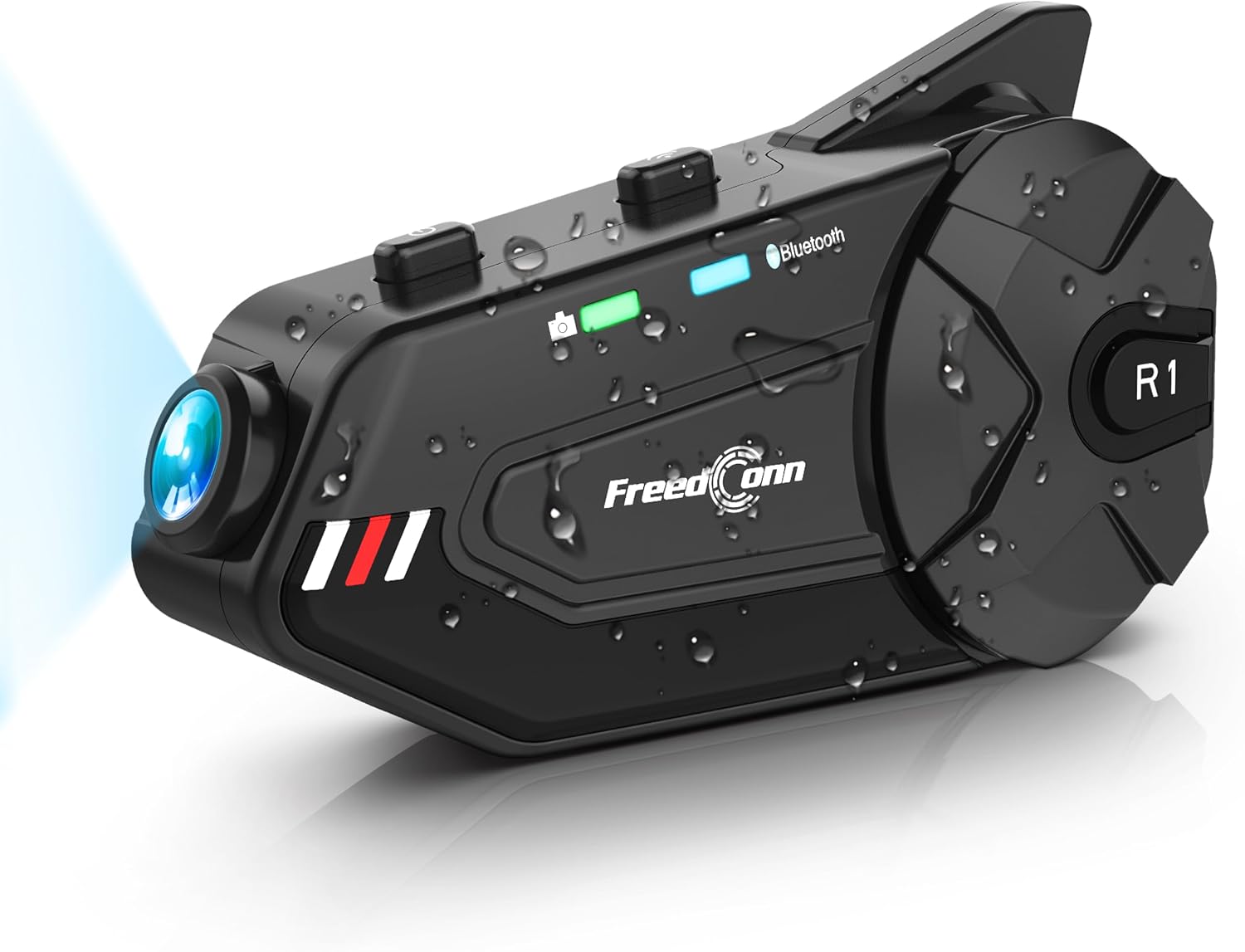
FreedConn R1 Plus
The FreedConn R1 Plus is the most widely reviewed clip-on Bluetooth camera unit on Amazon. It attaches to any helmet using adhesive pads or universal clips, records 1080p forward footage through a 120-degree wide-angle lens, connects to up to six riders for intercom communication up to 1,200 meters, and handles GPS navigation audio, calls, and music through built-in speakers and a microphone.
The built-in gravity shock sensor is the feature most relevant to delivery riders: if the sensor detects a collision or sudden impact, it automatically locks the current footage segment so the loop recording cannot overwrite it. You do not have to remember to save the clip when something happens. The camera saves it for you.
Battery life is approximately 4 to 5 hours of continuous video recording, which covers a standard dinner block. A full charge from empty takes 2 hours. The unit charges via USB while mounted, so you can top it up between blocks.
The one thing I do not love about it: The video quality at 1080p is functional for documentation purposes but noticeably behind what a GoPro Hero 13 or DJI Osmo Action 5 Pro delivers. In good daylight conditions the footage is clear and adequate for dispute documentation. In low light or rain, it degrades faster than a dedicated action camera. For riders whose primary concern is having footage running, it works. For riders who want the best possible footage quality, a clip-on action camera on a chin mount produces better results.
The app for viewing footage is called Roadcam and requires download before the first use. Footage transfers over Wi-Fi from the unit to your phone. This works but is slower than direct SD card transfer.
Note: The R1 Plus does not come with an SD card. You need a microSD card separately. A 32GB card at Class 10 or U3 handles the recording requirements at around $8 to $12.
- Auto-save shock sensor locks footage automatically on impact without any action from the rider
- Connects up to six riders on intercom up to 1,200 meters, genuinely useful for group delivery fleets
- Clips onto any existing certified helmet so you protect your current safety investment
- USB charging while mounted means you can top up between blocks without removing the unit
- Video quality degrades noticeably in low light and rain compared to a dedicated action camera
- No SD card included and footage Wi-Fi transfer is slower than direct card access
MAXTO M3
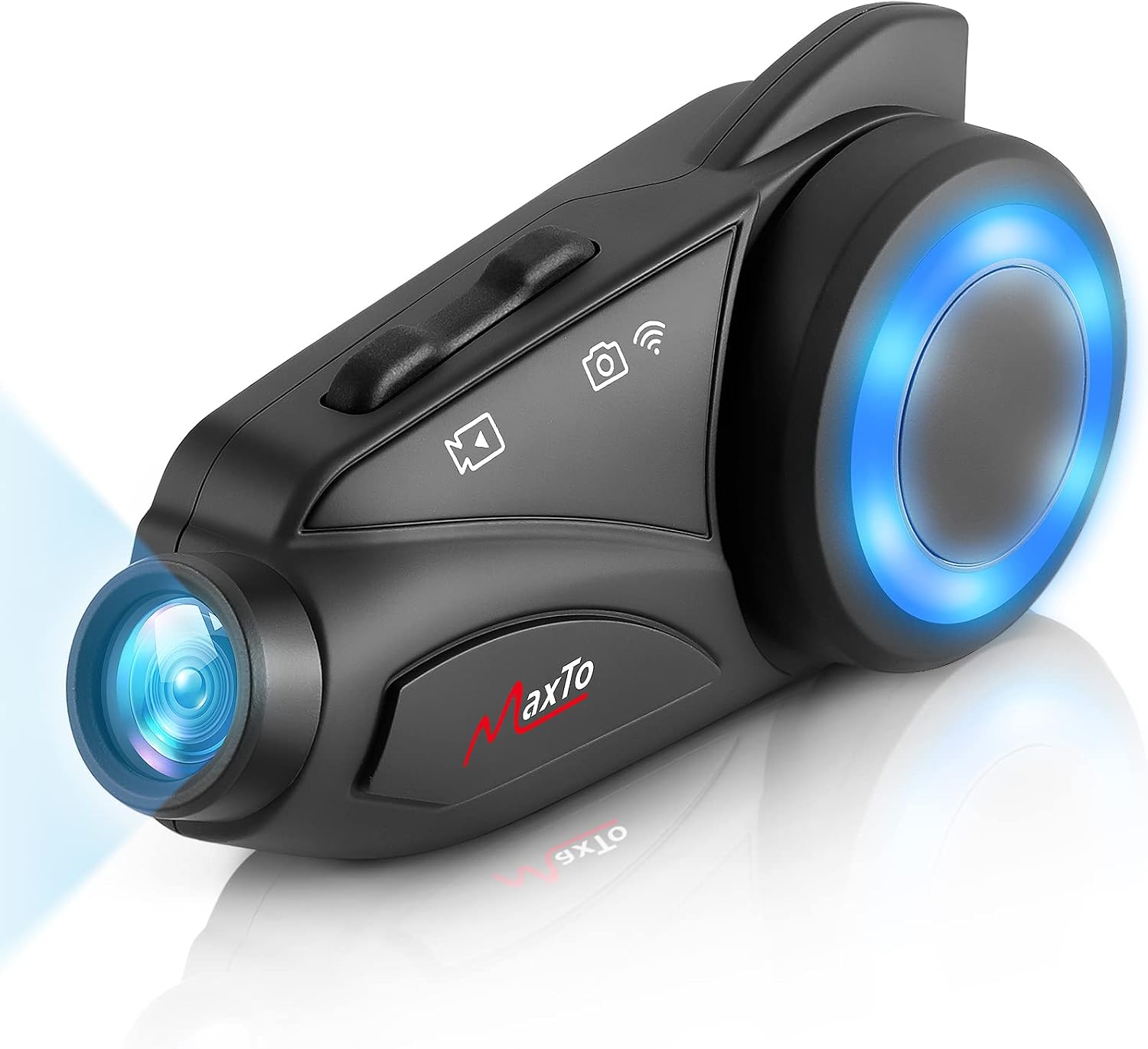
The MAXTO M3 is the alternative to the FreedConn R1 Plus in the same clip-on category. It adds a 360-degree adjustable camera mount, which allows you to angle the camera toward the chin area for more of a forward-road-at-handlebar-height view rather than the straight-forward camera angle that most clip-on units produce.
For delivery riders who want the clip-on convenience of a unit that attaches to an existing helmet but want a slightly more useful camera angle for documentation, the adjustable mount on the MAXTO is the differentiating feature. A camera angled down toward 15 to 20 degrees below horizontal captures hands, handlebars, and forward road interaction more usefully than a camera pointing straight ahead.
The 6-rider intercom, 1200-meter range, Bluetooth navigation audio, and GPS integration function similarly to the FreedConn. Battery life is approximately 5 hours of video recording.
The one thing I do not love about it: The MAXTO has fewer Amazon reviews than the FreedConn, which means less established real-world reliability data. The reviews that exist are positive, but with fewer units in the field, edge-case failures are less documented. If reliability track record matters more than the adjustable camera feature, the FreedConn's larger review pool gives more confidence.
- 360-degree adjustable camera mount lets you dial in a downward angle that captures road interaction more usefully than a fixed straight-ahead lens
- Five hours of continuous recording battery life edges out the FreedConn for longer shifts
- Clips onto any existing helmet so no helmet replacement cost is required
- Six-rider intercom at 1,200 meters matches the FreedConn on communication range
- Smaller review pool than the FreedConn means less documented reliability data for edge-case failures
- Adjustable mount adds a mechanical joint that is a potential failure point over time
Type 2: Full Smart Helmets
DC Smart Bike Helmet with Cameras Dual HD Front & Rear Video Recorder for Ebike & Electric Scooter, Bluetooth App Control Action Cam Helmet, CPSC Certified
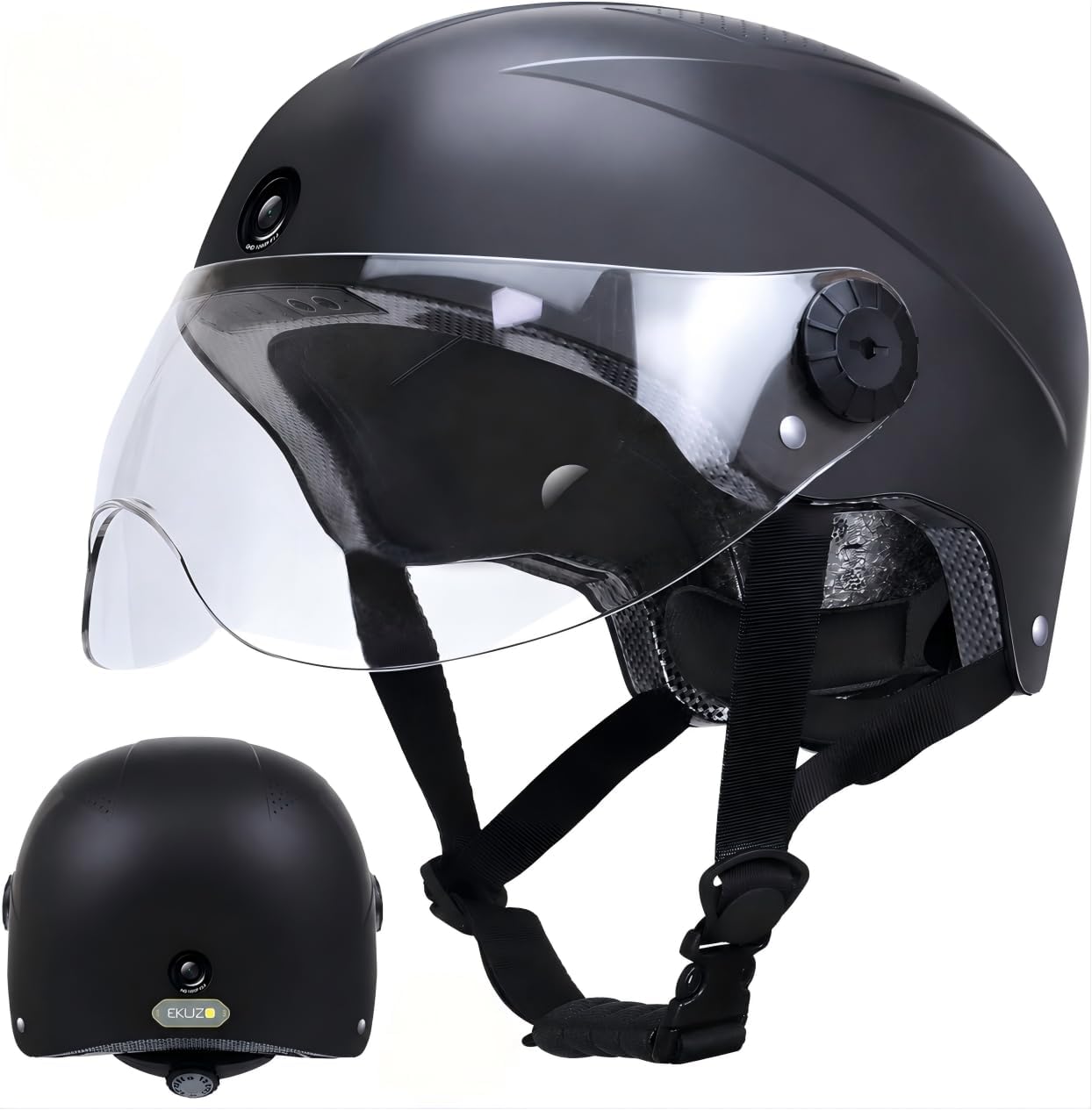
The DC Smart Bike Helmet is a full smart helmet built by EKUZO with dual integrated cameras, Bluetooth connectivity, and CPSC certification. It is designed specifically for e-bike and electric scooter riders who want front and rear footage coverage, hands-free communication, and a single device that handles documentation and audio without any external add-ons.
For a delivery rider who wants the most complete camera coverage available in a smart helmet, the DC's dual-camera system is the standout feature. The front camera records at 2K resolution when configured through the app, and the rear camera records at 1080p simultaneously. This means you have forward road coverage and rear traffic coverage running at the same time. Most clip-on units give you one camera angle. The DC gives you both.
The helmet powers on recording automatically the moment you turn it on. You do not have to open the app, tap a button, or configure anything before your shift starts. This is a meaningful operational advantage for delivery riders who are moving quickly between pickups and do not want to manage device setup at the start of every block.
Bluetooth connects your phone for hands-free calls, navigation audio, and music playback. The Smart Helmet Pro app handles video editing and sharing for post-ride review. One important caveat worth knowing before purchase: when the app is open, the Bluetooth audio connection pauses. When the app is closed, Bluetooth works without interruption and recording continues regardless. For riders who use navigation audio through Bluetooth during their shift, the practical workflow is to keep the app closed while riding and open it only when reviewing footage after the shift ends.
Battery life is 4 hours of continuous recording with IPX5 water resistance, which handles rain without damage to the electronics. The EPS protective shell fits head circumferences from 21 to 24.8 inches and is CPSC certified for cycling use.
The one thing I do not love about it: The DC Smart Bike Helmet does not carry NTA 8776 certification, which is the e-bike specific standard covered in the e-bike helmet guide. For e-bike delivery riders in New York where this certification matters for building charging compliance, adding a clip-on unit to an NTA 8776 certified helmet remains the route that satisfies both the safety standard and the camera documentation requirement simultaneously. The DC is CPSC certified, which covers general cycling safety, but the NTA 8776 standard is an additional layer specific to higher-speed e-bike use.
- Dual front and rear cameras give you simultaneous 2K front and 1080p rear coverage that no clip-on unit in this price range can match
- Auto-records the moment the helmet powers on so there is zero setup step at the start of every shift
- CPSC certified with IPX5 water resistance, covering both safety compliance and all-weather shift use
- Bluetooth handles calls, navigation audio, and music without any external hardware to mount or manage
- Opening the Smart Helmet Pro app during a ride pauses Bluetooth audio, requiring riders to keep the app closed while riding
- Lacks NTA 8776 certification, which matters for e-bike delivery riders in New York requiring building charging compliance
| Best E-Bike Helmet for Delivery Riders →
A Correction from the Camera-in-Helmet Article
The previous article in this cluster referenced the Sena M1 EVO as a helmet with a built-in camera. That was incorrect. The Sena M1 EVO is a mountain bike helmet with Bluetooth speakers, Mesh intercom, and an LED taillight. It does not have a built-in camera. It is not a motorcycle helmet. For delivery riders researching the M1 EVO based on that reference, the FreedConn R1 Plus or MAXTO M3 are the correct clip-on units to look at, and the DC Smart Bike Helmet is the correct full-helmet option with integrated dual-camera documentation built in.
Who Should Buy What
Buy a clip-on unit (FreedConn or MAXTO) if:
You already have a helmet you trust, particularly one with NTA 8776 or DOT certification that meets the safety standard for your vehicle type. You want documentation capability and navigation audio without replacing a helmet that is doing its job. Your budget is $60 to $90 rather than $100 or more.
Buy the DC Smart Bike Helmet if:
You are replacing your helmet and want dual front and rear camera coverage built directly into the shell without mounting anything externally. You are on an e-bike or electric scooter where CPSC certification satisfies your compliance requirement. You want automatic recording from the moment the helmet powers on so there is no setup step at the start of every shift.
Use a dedicated action camera on a chin mount instead if:
Video quality is the priority, particularly for night shifts or dispute documentation in low-light conditions. A GoPro Hero 13 or DJI Osmo Action 5 Pro produces significantly better footage than any built-in camera at this price point. The trade-off is a separate device to charge and manage.
The Bottom Line
Built-in camera and Bluetooth in a single helmet is a real convenience. The clip-on units give you that convenience at $60 to $90 without replacing a helmet. The DC Smart Bike Helmet gives you dual front and rear camera coverage plus Bluetooth audio in a complete CPSC certified helmet at a competitive price point.
For most delivery riders with an existing certified helmet, the FreedConn R1 Plus or MAXTO M3 is the right answer. The auto-save shock sensor on the FreedConn specifically is the feature that matters most for dispute documentation: the footage saves itself when something happens instead of relying on you to act before the loop overwrites it.
For riders starting fresh on a helmet purchase who want the most complete camera coverage available in a single device, the DC Smart Bike Helmet delivers both front and rear documentation in one shell at a price that is still well below the flagship smart helmet tier.